Car rental geofencing setup guide
A practical implementation guide for rental businesses and technology teams preparing a supported Hannk deployment.
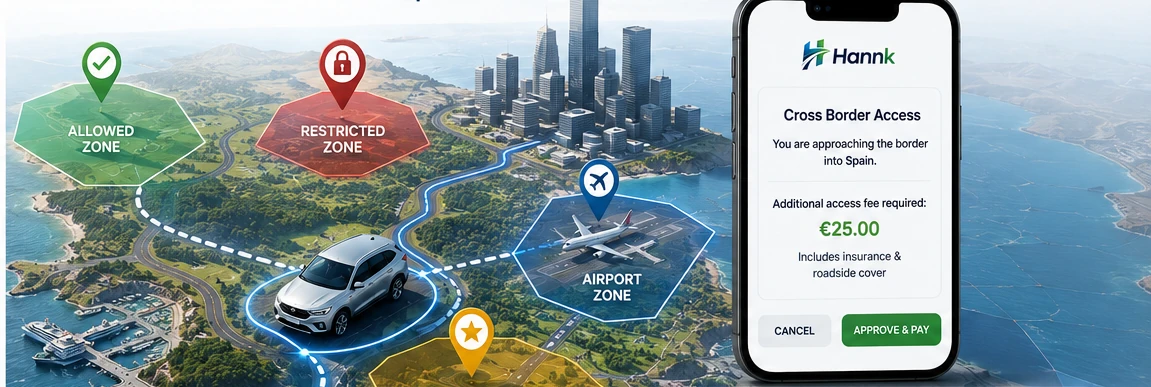
Define what each zone means
A rental geofence is useful when it supports a defined operational decision. A branch zone, collection area, return location and permitted operating region can have different meanings. Document the purpose and owner of each rule before drawing boundaries.
Do not use a location event as a substitute for the rental agreement. A geographic restriction should be communicated clearly to the customer and reviewed under the operator’s applicable conditions and legal requirements.
Match the boundary to location quality
Confirm the positioning signals, reporting interval and expected accuracy for the actual deployment. Large geographic areas and narrow parking areas demand different interpretations. Indoor parking and nearby buildings can make precise positioning difficult.
Test vehicles near a boundary and consider how transient movement or uncertainty should be handled through the supported configuration. Confirm available behaviour with Hannk rather than assuming every rule type or positioning function exists.
Map events to the rental
Associate an event with the correct vehicle and current rental assignment. Record when the location was observed, not only when a notification arrived. A delayed event may relate to a previous rental or an authorised staff movement.
Check the permitted journey, vehicle substitution and branch activity before contacting a customer. Location information needs its operational context to be useful and fair. Assign a staff owner to review ambiguous events.
Design collection and return workflows
Use a collection zone with clear directions, vehicle registration and parking information. At an airport, include the relevant terminal, level and bay where required; a map pin may not be enough to find the correct vehicle.
For return, combine the configured location event with condition evidence, vehicle identity, locking confirmation and operator checks. Avoid closing every rental solely because a vehicle enters a geographic area.
Plan cross-border and layered rules
A cross-border alert should be assessed against the rental’s agreed operating area and the quality and timing of the observation. Define what staff do when they receive it and how an authorised exception is recorded.
For nested zones or Hannk 3D GeoLayers, document rule relationships and confirm supported features with Hannk. Layered geographic logic does not itself prove indoor floor position. Test adjacent areas and overlapping business requirements.
Test, review and maintain
Pilot the rule set with ordinary movements, boundary-adjacent routes, weak coverage and a stopped data feed. Check that notifications reach the right team and do not create repeated unnecessary interruptions. Use the results to refine the agreed configuration.
Revisit zones when a branch moves, airport parking changes or vehicle reporting behaviour changes. Maintain appropriate customer privacy information and staff access controls. Keep evidence of the decision behind an alert, not just a list of notifications.